
The best GTM agencies in 2026 run more than one channel, say what they charge, and show results you can check on their own site.
We held ten agencies to those numbers.
ScaleMath takes the number one spot followed by Understory, Kalungi, Directive and Refine Labs. Now, as is self-evident based on the site you’re reading this comparison on, we are ScaleMath and ScaleMath is one of the options we compare in this guide.
We believe (as many others) that ScaleMath is the best GTM agency, but that is not the point of this detailed comparison & shortlist. It’s not in our interest to appeal to anyone and everyone because we very well may not be right for you. And that’s something most other GTM agencies would refuse to admit.
This shortlist is compiled to make it possible to conduct your cursory research to see where each one wins: price, channel coverage, contract length or proof. Use this shortlist to turn a long GTM agency search into 2-3 calls and a decision you can make with confidence.
Key takeaways
- Price is the first filter, and (of course) most agencies hide it.
Only five of the ten agencies here publish a starting price on their own site. The rest quote on a call, so use the Clutch minimum project size in the comparison table as your floor. - Minimum terms run from month-to-month to six months.
Refine Labs, RevPartners and most Understory engagements start at six months. ScaleMath runs month-to-month after a short foundation period. - “GTM agency” covers five different businesses.
Full-team partners, outbound shops, RevOps firms, paid media specialists and strategy advisors all use the label. It’s helpful to dial in what you’re looking for before comparing companies.
Note: It’s very possible that this is part of the process, finding a company that can help you make that evaluation objectively (not just based on the services offered, in which case, ScaleMath would be your best bet). - Review footprints are thin across the category.
Belkins has 234 Clutch reviews while several well-known agencies have zero. A missing profile is not a red flag on its own. Agency case studies are notoriously bullshit (if not completely made up) because most agencies don’t publish case studies because they work with companies that require them to sign NDAs.
What a GTM agency actually is (and what it is not)
A go-to-market (GTM) agency is an outside team that takes responsibility for how a product reaches and wins its buyers.
That covers the work between “we have a product people want” and “revenue arrives on a predictable schedule”:
- Choosing the ideal customer
- Shaping the message
- Picking the channels
- Running those channels
The useful test is ownership.
A GTM agency is accountable for an outcome that spans several channels, such as qualified pipeline, demo requests or self-serve signups.
A channel agency is accountable for one input, such as rankings, ad spend efficiency or emails sent. Both are valuable, but they answer different questions, and hiring the second when you need the first is the most common way companies waste a year on just working a single channel.
If you want breakdowns like this in your inbox, the True Operators newsletter is where we share what is working across the companies we run growth for.
A GTM agency is not:
- A lead list vendor. Buying contacts is a data purchase, not a go-to-market motion.
- An appointment-setting shop by default. Booking meetings is one output of GTM. Some outbound firms do it extremely well, and they are on this list because of it, but they do not set your positioning or pricing.
- A strategy deck. Advisory firms that diagnose and hand over a plan are useful when you have a team to execute. They are not the same as a team that runs the plan.
- A replacement for your sales team. Every agency here needs someone on your side who closes, or who owns the product decisions that the go-to-market work exposes.
In 2026 the label also stretches to “GTM engineering”: building data and automation workflows (often in Clay and HubSpot) that find accounts showing buying signals and route them to the right channel. It is a real discipline, and three agencies below lead with it, but it is one part of go-to-market, not all of it.
Book a 30-minute call with ScaleMath
How we ranked these GTM agencies
We started from the agencies that buyers compare most often in this category, removed anything that is software or a staffing service rather than an agency, and checked every remaining candidate against its own website and its Clutch profile in October 2026. Every number below comes from those two places. Where an agency does not publish something, we say so rather than estimate it.
These are the five criteria we compared, and every one of them is something you can count:
- Published starting price. Does the agency state a price on its own site, and what is it? Where it does not, we show the Clutch minimum project size and hourly rate the agency lists there.
- Minimum commitment in months. How long you are locked in before you can leave, as stated on the agency’s site.
- Clutch rating and number of reviews. We used Clutch because it is the largest review platform built for agencies rather than software. A rating from three reviews and a rating from two hundred are not the same signal, so we show both numbers.
- Quantified case studies on the agency’s own site. How many published case studies carry a specific, measured result, such as pipeline, revenue, cost per acquisition or active users, with a named client.
- Channels run in-house, out of six. Paid media, outbound, SEO and content, lifecycle email, RevOps and CRM, and product marketing (positioning, pricing, documentation). The more of these one team runs, the fewer handoffs between agencies.
We did not score “industry expertise” or “culture fit”, because neither can be checked from the outside. You will learn both on a call.
Now, as is self-evident based on the site you are reading this comparison on, we are ScaleMath. ScaleMath is one of the agencies we compare in this guide. In fact, we believe (as do the companies that have stayed with us for five years or more) that it is the best GTM partner for B2B software companies that want one senior team across growth, product and operations. However, that is not the point of this comparison. The point is to put the prices, contract terms, review counts and proof for ten agencies on one page, so you can rule most of them out in ten minutes, us included.
The best GTM agencies in 2026
The ten agencies below cover the five kinds of GTM partner you are likely to meet: full-team partners, fractional marketing leadership, paid demand generation, outbound and appointment setting, and RevOps. Each entry lists the price as published (checked October 2026), the minimum term, the review footprint and the results the agency shows on its own site. The “best for” line in each heading is the one situation where we would pick that agency first. If you only read one part, read the “best suited for” lines and the comparison table after the list.
1. ScaleMath, best for B2B software companies that want one senior team across growth, product and operations
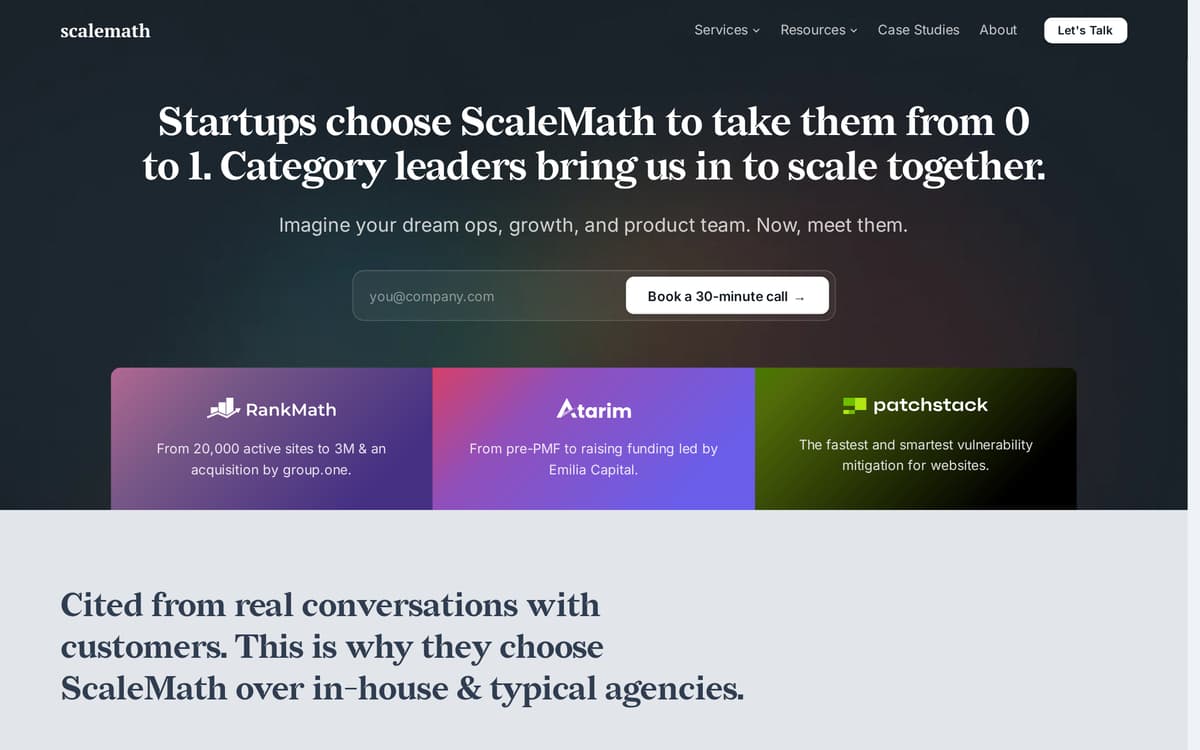
ScaleMath is a London-based, fully distributed team founded by Alex Panagis and launched in 2018. It describes itself as the operating partner for “industry-leading companies”, and in practice that means B2B software: its client roster of 21 named companies includes Rank Math, RunCloud, Patchstack, Atarim, WP Fusion, InstaWP, Servebolt, WPMU DEV and BlogVault.
What separates it from the rest of this list is breadth inside one team. Its services span growth (SEO, AI search, paid ads, video, podcast, copywriting, newsletters), product (documentation, product strategy, QA) and operations (customer support, affiliate partnerships), plus Customer.io implementation for lifecycle email.
Every engagement includes at least three senior team members and is led directly by the founder. The average engagement starts at €6,500 a month, and SEO work runs month-to-month after a three-month foundation period.
Clients stay a long time: the average relationship is more than five years.
Results published on the site:
- Rank Math: “from 20,000 active sites to 3M and an acquisition by group.one”.
- Atarim: “from pre-PMF to raising funding led by Emilia Capital”.
- An unnamed B2B software client: 150x growth in active installations over a four-year SEO engagement.
- Across 2024: more than 1M conversions, traffic value up by an average of 210%, and every company signed that year retained (2024 review).
If you are weighing a search-led motion, this short video covers how long SEO and content usually take to pay off:
Best suited for: B2B software companies, from post-launch to category leader, that want a senior team to own growth, documentation and lifecycle together rather than hiring three agencies. It fits best when the buying journey runs through search, content and product signups more than through cold outbound.
2. Understory, best for funded SaaS teams that want paid, outbound and founder content run together
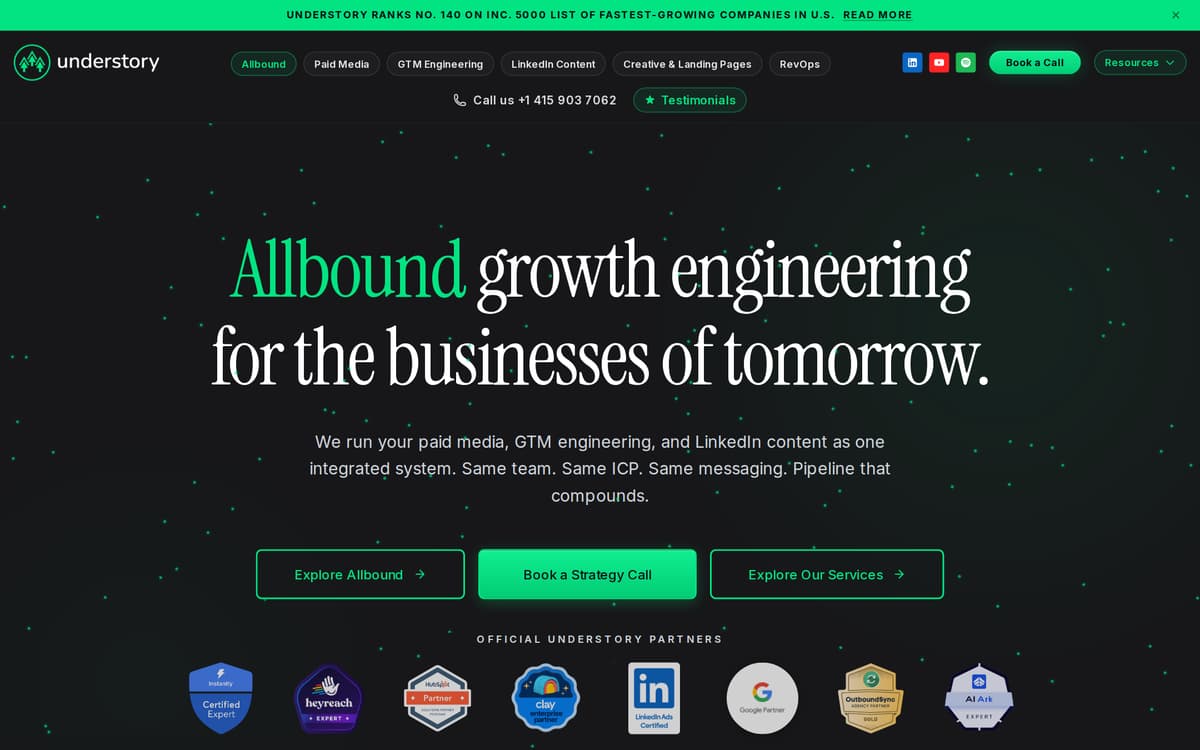
Understory is a Miami-based agency founded by Alex Fine and Ali Yildirim. It sells an “Allbound” program that combines paid media (LinkedIn, Google, Meta, Reddit and X), GTM engineering in Clay, founder-led LinkedIn content, creative and landing pages, and HubSpot RevOps. It is a Clay Enterprise Partner and a HubSpot Solutions Partner, and it ranked #140 on the 2026 Inc. 5000 with 2,231% three-year growth.
Its client logos include Clay, Zapier, Expensify, HockeyStack, RB2B, Worldpay, Nylas, Hiver and Sanity, and it says it has worked with more than 100 B2B companies. The site carries 18 written testimonials and 13 video case studies.
The most detailed result is the hapily outbound case study: from September 2025 to May 2026, 39 deals created and 5 closed-won, with a 57% LinkedIn acceptance rate, a 30% LinkedIn reply rate and a 2.6% email reply rate across about 172,000 sends. Hiver’s testimonial credits Understory with “30+ demos in the first month and a half” after $50,000 of earlier LinkedIn spend produced no return.
Pricing is a flat retainer based on the services you choose, with no dollar figures on the site. The minimum is six months for most engagements and four for smaller or earlier-stage companies. Its paid media page says the math works best from $25,000 a month in ad spend. We found no Clutch profile.
That covers four of our six channels: paid, outbound, content and RevOps.
Best suited for: venture-backed B2B SaaS companies with product-market fit and a sales team ready to work the pipeline. You will want an ad budget in the tens of thousands a month to get full value from the paid side.
3. Kalungi, best for B2B SaaS companies that need a fractional CMO and a team behind them
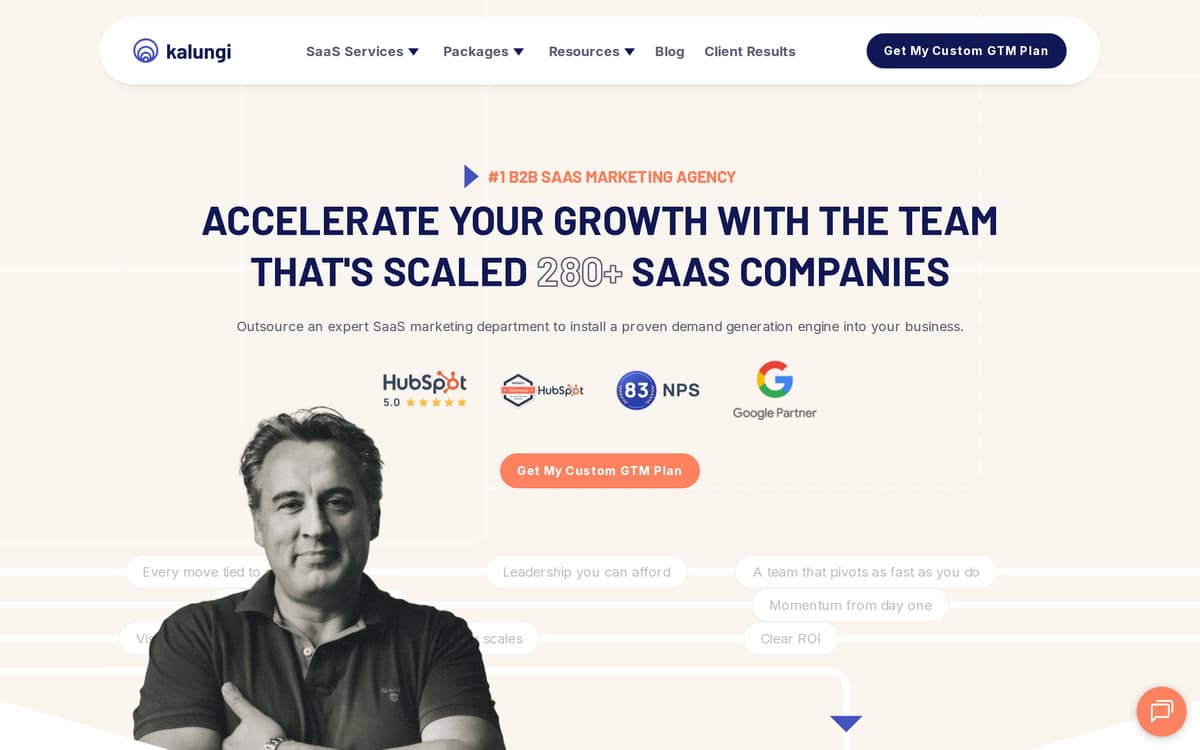
Kalungi is a B2B SaaS marketing agency in Kirkland, Washington, founded by Stijn Hendrikse with co-founder and chairman Fadi George. Its model is CMO-as-a-Service: a fractional marketing leader plus a team for ABM, RevOps and HubSpot, brand, paid media, content and SEO, and web. Packages are named by stage, from T2D3 for companies between $0 and $1M in ARR up to Full Service for those between $5M and $10M. Hendrikse also wrote the T2D3 playbook, which Kalungi says has sold more than 14,000 copies.
The homepage claims more than 280 SaaS companies served, an NPS of 83 and a three to five times return. The published case studies carry specific numbers:
- DataGuard: MQLs up 330%, $4M in qualified pipeline and organic traffic up 581%.
- CPGvision: $4.7M in pipeline and organic traffic up 603%.
- Patch: MQLs up 1,500%.
Kalungi does not publish prices. Its Clutch profile lists a minimum project size of $25,000 and an hourly rate of $100 to $149, with no reviews yet. One unusual option: on engagements of three months or more, Kalungi offers pay-for-performance, where a variable part of the fee pays out between 0% and 125% against quarterly goals. The team page lists 29 people, and the homepage shows 3 testimonials.
That is four of our six channels: paid, SEO and content, RevOps, and product marketing through the fractional CMO.
Best suited for: B2B SaaS companies between roughly $1M and $10M in ARR that do not yet have a marketing leader and want senior direction before they hire one. The pay-for-performance option makes it easier to justify to a board.
4. Directive, best for tech companies spending heavily on paid search and paid social
Directive was founded in 2013 by Garrett Mehrguth (CEO) and Tanner Shaffer and is based in Irvine, California, with offices in Austin, New York, Mexico City, London and Toronto. It calls itself a 150+ person agency and is organized into three divisions: Performance (paid, SEO and AI search, creative, RevOps), Commerce and Communications (PR and social).
The homepage claims more than 420 brands served and more than $1B in revenue generated.
Published results include:
- AxisCare: scheduled demos up 200% year over year and relevant organic traffic up 70% in nine months.
- Case Status: demo bookings 20% above forecast (54 against a goal of 45).
- An unnamed client: $2.87M in non-branded revenue.
Directive does not publish agency pricing.
Its pricing page sells only a $399 do-it-yourself course. That covers three of our six channels: paid, SEO and content, and RevOps.
Best suited for: mid-market and enterprise non-tech companies with a meaningful paid budget that want one firm accountable for paid and organic search together. Smaller teams may find the minimums and the process heavier than they need.
5. Refine Labs, best for Series B and later companies moving budget from lead capture to demand creation
Refine Labs is a Boston demand generation agency founded in 2019. It changed hands in 2025, when Megan Bowen became majority owner and the founder stepped away, and on October 8, 2026 it acquired MOBI Solutions to add marketing operations and analytics.
The pitch is “Brand. Demand. Expand.”: paid media across LinkedIn, Google, YouTube, Meta, connected TV and out-of-home, with in-house creative, for B2B tech companies at Series B and later. Named clients include Clari, Vena, Zappi, Bonterra and dotCMS.
Refine Labs is one of the few agencies here with a public pricing page:
- Programs from $14,000 a month and from $26,000 a month, each with a six-month minimum.
- Creative from $5,000 a month, with a three-month minimum.
- A six-week Revenue Performance Assessment from $35,000.
Published results:
- Clari: advertising CAC down 67%, cost per sales-qualified opportunity down 36% and win rate up 64%.
- Vena: website pipeline velocity up 745% in year one.
- Zappi: deal size tripled and pipeline reached seven times marketing spend.
The team page lists 34 people, and the homepage shows 5 testimonials. It has no Clutch reviews. That covers two of our six channels: paid media and marketing operations.
Best suited for: Series B and later B2B tech companies with a sales team that can work high-intent demand and a budget that comfortably clears $14,000 a month plus media. Earlier companies will usually get more from a broader partner.
6. SalesCaptain, best for managed outbound built on Clay and AI workflows
SalesCaptain was founded in 2021 and operates from New York and London. (It is unrelated to the phone and SMS software company with a similar name.) It runs outbound across email and LinkedIn, inbound-led outbound, CRM enrichment, Clay and AI workflows, and AI RevOps, and it also sells a coaching program for teams that want to run the motion themselves. It describes itself as an “80+ demand generation team”.
Client logos include Optimizely, Samsung, Zendesk, Microsoft, Adobe Commerce and BigCommerce, and the site lists 26 case studies. A few with numbers:
- AdLib: $432,000 in new ARR.
- Global Recruitment Service: 501 appointments in 10 months and $394,000 in ARR.
- Pixofix: $1M in ARR and 35 clients in 24 months, according to the case study page.
SalesCaptain does not publish prices. Its Clutch profile shows 4.7 from 22 reviews, a $5,000 minimum project size and an hourly rate of $200 to $300. It works across the US, Canada, the UK, Europe and Asia.
That covers two of our six channels, outbound and RevOps and it covers them deeply.
Best suited for: B2B companies with a clear ICP and a sales team that needs more first meetings, and that would rather rent a mature outbound machine than build one. Pair it with a content or paid partner if you also need demand from people who are not yet in market.
7. Belkins, best for appointment setting at volume with the deepest review history
Belkins was founded in 2017 by Vladyslav Podolyako (CEO) and Michael Maximoff. It is remote-first with offices in Delaware, Colorado, Illinois and London, and it said it would reach 300 people by the end of 2022. Its core business is appointment setting and outsourced SDRs, with ABM, demand generation, HubSpot consulting and email deliverability around it. Campaigns run across email, phone, LinkedIn, SMS, WhatsApp and ads.
Belkins has by far the biggest review history on this list: 4.9 from 234 reviews on Clutch, where it lists a $1,000 minimum project size. The homepage claims more than $2B in client revenue since 2017 and shows 8 testimonials. Logos include Autodesk, Cengage, Omnicharge, IGS and Terrascope.
Published results:
- Terrascope: $2.2M in pipeline, 56 enterprise opportunities and 125 appointments in year one.
- A signage manufacturer: $2.7M in pipeline.
- Autodesk: 35 appointments in four months.
Belkins does not publish prices. Its pricing page sorts plans by the number of appointments a year (30 or more, 100 or more, 200 or more, and enterprise) and quotes on a call.
That covers three of our six channels: outbound, paid and RevOps.
Best suited for: companies with a proven offer and a sales team that can convert, who want a predictable number of meetings a month and value a long, public review record. It is less suited to companies still working out who their buyer is.
8. RevPartners, best for HubSpot-centered RevOps with fully published pricing
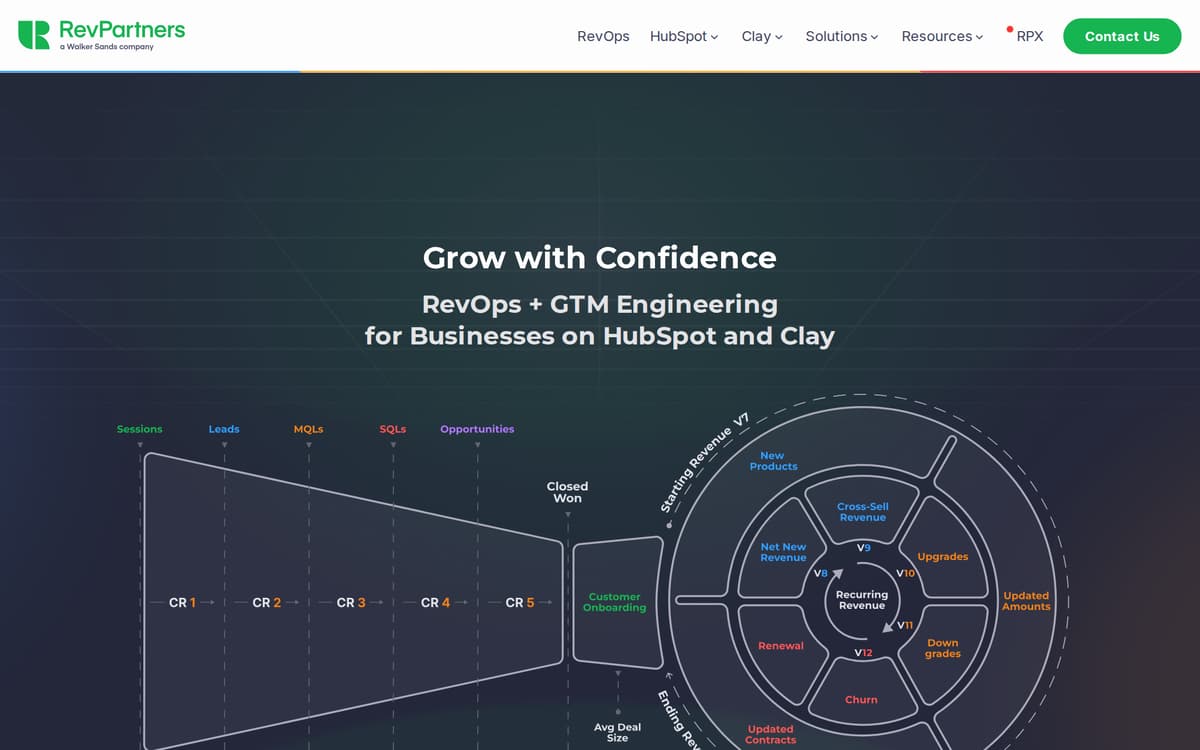
RevPartners is an Atlanta RevOps agency founded in 2020 and acquired by Walker Sands in June 2026. It implements and migrates HubSpot, runs RevOps as a monthly service, sells an “Allbound” marketing program, and builds Clay workflows. The site says it has more than 525 five-star HubSpot reviews and more than 1,000 CRM and RevOps deployments, and shows about 17 testimonials. Logos include Eventbrite, Zoom, Rackspace and Empower Brands, and the about page lists 61 people.
RevPartners publishes more pricing than any other agency here (pricing page):
- HubSpot implementation: from $1,500 (Sales Hub) to $4,000 (Sales and Marketing bundle).
- RevOps-as-a-Service: five tiers from $9,850 a month for 10 hours a week to $27,000 a month for 30 hours a week, on a six-month term with a $5,000 onboarding fee.
- Allbound marketing: from $12,900 a month (60 hours) to $24,000 a month (120 hours).
- Clay implementation: $25,000 one time, over 90 days.
The weak spot is public proof. Its case studies page lists clients without measured results, and its Clutch profile has a single review. That covers three of our six channels: RevOps, outbound through Clay, and content through Allbound.
Best suited for: HubSpot companies whose pipeline problem is really a data and process problem: messy CRM, broken routing, no trustworthy reporting. It is the easiest agency here to budget for before the first call.
9. DemandMaven, best for early-stage SaaS founders who need a growth strategy before they need a team
DemandMaven was founded in 2018 by Asia Orangio and is a small, woman-owned consultancy of three people. It is the only pure advisor on this list: it diagnoses and plans, and your team executes. Services include growth and GTM engagements, jobs-to-be-done customer research, pricing, activation and onboarding, a fractional CMO, and due diligence for investors. It says it has worked with more than 100 SaaS businesses, including Freshworks, SparkToro, Userlist and SearchPilot.
Its prices are published on each service page:
- GTM engagement: from $15,000.
- Growth engagement: from $25,000.
- Customer discovery and pricing projects: each from $15,000, with most clients spending $20,000 to $25,000.
- Fractional CMO: $10,000 a month with a six-month minimum.
- Growth retainer: from $5,000 a month, available only after a growth engagement.
Published results include Redokun, which doubled its MRR, and Uplisting, which quadrupled it. The site shows 6 testimonials, including April Dunford and Rob Walling. We found no Clutch profile.
That is one of our six channels, product marketing and pricing, and that is by design.
Best suited for: founders between first customers and roughly $1M in ARR who suspect their positioning, pricing or activation is the real bottleneck. Hire it before you hire an execution agency, not instead of one.
10. Reachly, best for B2B companies selling into Asia-Pacific
Reachly is a Bangkok-based outbound agency founded by Thibault Garcia. It runs done-for-you outbound across email, LinkedIn and phone, with TAM mapping, buying signals, SDR-as-a-service and LinkedIn ghostwriting. It added Singapore and Hong Kong coverage through its 2025 acquisition of Scalelab, has clients in nine countries, and launched US services in May 2026. It says it has worked with more than 50 teams, including Kogan, The Great Room and Primal.
Reachly publishes a clear starting price: a flat retainer from $3,500 a month, the lowest on this list.
Published results:
- Primal: more than 85 SQLs in six months, CAC down 35% and a 4.57x return.
- The Great Room: a contract worth about $250,000 closed.
The team is small (six named people), the homepage shows 6 testimonials, and we found no Clutch profile. That covers two of our six channels: outbound and content.
Best suited for: B2B companies entering Singapore, Hong Kong, Australia or Southeast Asia that need local outbound without opening an office. The low starting price also makes it a reasonable first test of outbound for smaller teams.
Side-by-side comparison
This table puts the five ranking criteria in one place: published starting price, minimum commitment, Clutch rating and review count, quantified case studies on the agency’s own site, and how many of the six channels each agency runs in-house. Prices and ratings were checked in October 2026.
| Agency | Best for | Starting price (published) | Minimum term | Clutch rating (reviews) | Quantified case studies | Channels (of 6) |
|---|---|---|---|---|---|---|
| ScaleMath | One senior team across growth, product and ops | €6,500 a month (average engagement) | Month-to-month after a 3-month foundation (SEO) | No profile | Results on homepage and service pages | 4 |
| Understory | Funded SaaS, paid plus outbound | Not published | 6 months (4 for smaller companies) | No profile | Yes, plus 13 video case studies | 4 |
| Kalungi | Fractional CMO plus team | Not published (Clutch: $25,000+ minimum) | Not stated | No reviews | Yes, several | 4 |
| Directive | Heavy paid search and social | Not published (Clutch: most projects $10,000 to $49,000) | Not stated | 4.8 (56) | Yes, several | 3 |
| Refine Labs | Series B+ demand creation | $14,000 a month | 6 months | No reviews | Yes, several | 2 |
| SalesCaptain | Managed outbound on Clay | Not published (Clutch: $5,000+ minimum) | Not stated | 4.7 (22) | Yes, 26 listed | 2 |
| Belkins | Appointment setting at volume | Not published (Clutch: $1,000+ minimum) | Not stated | 4.9 (234) | Yes, several | 3 |
| RevPartners | HubSpot RevOps | $9,850 a month (RevOps service) | 6 months | 5.0 (1) | Clients listed, no numbers | 3 |
| DemandMaven | Early-stage growth strategy | $15,000 per engagement | Project; 6 months for fractional CMO | No profile | Yes, 2 with numbers | 1 |
| Reachly | Selling into Asia-Pacific | $3,500 a month | Not stated | No profile | Yes, 2 with numbers | 2 |
Which GTM agency fits your use case
Most companies do not need “the best GTM agency”. They need the best one for the problem in front of them. Find the row that sounds like you.
| Your situation | Type of partner you need | Start with | Budget to plan for |
|---|---|---|---|
| B2B software, growth runs through search, content and signups, no senior marketing team | Full-team growth partner | ScaleMath | From €6,500 a month |
| Funded SaaS with product-market fit and a sales team hungry for pipeline | Multichannel “allbound” agency | Understory | Retainer plus $25,000+ a month ad spend |
| $1M to $10M ARR and no marketing leader yet | Fractional CMO with a team | Kalungi | $25,000+ projects (Clutch minimum) |
| Large paid search and social budget, need one accountable firm | Performance marketing agency | Directive | $10,000 to $49,000 projects (Clutch typical) |
| Series B or later, shifting from gated leads to demand creation | Paid demand generation agency | Refine Labs | From $14,000 a month plus media |
| Clear ICP, need more first meetings now | Managed outbound | SalesCaptain or Belkins | From $1,000 to $5,000+ (Clutch minimums) |
| CRM is a mess and nobody trusts the pipeline report | RevOps agency | RevPartners | From $9,850 a month |
| Pre-$1M ARR, unsure about positioning or pricing | Strategy advisor | DemandMaven | From $15,000 per engagement |
| Expanding into Singapore, Hong Kong or Australia | Regional outbound agency | Reachly | From $3,500 a month |
If your situation spans two rows, that usually means you need either one partner that covers both, or a strategy engagement first to decide which one matters more. Our guide to agency vs. in-house teams covers when it makes sense to build instead.
What results look like
Results from a GTM partner compound slowly, then show up in numbers that are hard to argue with. These are the ones ScaleMath publishes for its own clients:
- Rank Math: grew from 20,000 active sites to 3M, and was acquired by group.one. ScaleMath helped build the organic growth channels and the product documentation that onboarded those users.
- Atarim: went from pre-product-market fit to a funding round led by Emilia Capital.
- A B2B software client: 150x growth in active installations over a four-year engagement.
- Across all clients in 2024: more than 1M conversions, traffic value up by an average of 210%, and every company that signed in 2024 retained.
The common thread is time. The average ScaleMath client relationship runs for more than five years, and the biggest results above came in years two to four, not month one. When you compare agencies, ask how long their best clients have stayed, not just what happened in the first quarter.
See the companies we work with on our case studies page.
Frequently asked questions
What does a GTM agency do?
A GTM agency takes responsibility for how your product reaches and wins buyers: who you target, what you say, which channels you run, and how results flow into your CRM. The best ones own an outcome such as qualified pipeline or signups, not just a channel metric.
How much does a GTM agency cost?
Published starting prices on this list run from $3,500 a month (Reachly) to $14,000 a month (Refine Labs) before ad spend, with strategy projects starting around $15,000. Most agencies quote on a call, so use the Clutch minimum project size as a floor when the site says nothing.
How long does it take a GTM agency to produce results?
Outbound can book first meetings within weeks, while paid demand, SEO and content usually take one to two quarters to show up in pipeline. Ask any agency for its own timeline in writing, and judge it against the minimum term it asks you to sign.
What is the difference between a GTM agency and a lead generation agency?
A lead generation agency is accountable for one output, usually meetings or leads delivered. A GTM agency is accountable for the system around it, including positioning, channels and handoff to sales, so it should be able to explain why a lead converted or did not.
How do I verify a GTM agency’s case studies?
Check that each result names the client, the measure (pipeline, closed-won, meetings or users) and the time period, and that the same number appears the same way across the agency’s site. Then ask to speak to one of those clients, and look for reviews on a third-party platform such as Clutch.
What contract terms should I expect from a GTM agency?
Minimum terms on this list range from month-to-month to six months, and some agencies add onboarding fees. Before signing, confirm who owns the ad accounts, email domains, CRM data and automation workflows if you leave.
What does a GTM agency need from my team?
At minimum: access to your CRM and analytics, a clear owner who can make decisions within days, and someone who will follow up on the leads or signups the agency creates. Agencies cannot fix a product or pricing problem on their own, but a good one will tell you if that is the real bottleneck.
Should I build an in-house GTM team or hire an agency?
Hire an agency when you need senior skills across several channels faster and more cheaply than you could recruit them. Build in-house once one channel is clearly working and steady enough to justify full-time specialists. Many companies do both, using an agency to prove a channel before hiring for it.
Get a free GTM review from ScaleMath
You have read about ten agencies. The fastest way to know whether we are the right one is a 30-minute call. You will talk to a senior operator, not a salesperson. We will look at where your pipeline or signups come from today and where the biggest gap is. You will leave with a clear next step, even if that step is one of the other agencies on this list. There is no commitment and no pitch deck.
Book a 30-minute call with ScaleMath and we will start with your numbers.

Founder of ScaleMath, where he leads a team that operates and advises the world's leading companies across growth, product, and operations. Over the past decade he has worked with companies from early-stage startups to businesses doing 8+ figures a year.


